Executive summary
This guide is written for readers who want a practical, technically informed, and search-friendly overview of iptv suomi without relying on thin doorway copy. It explains what modern IPTV means, how to evaluate a service, what devices and network settings matter, and how to organize a household streaming setup that is stable, understandable, and compliant with local rules. If you are comparing providers, start with a transparent information source such as iptv suomi and compare it with your own checklist for content rights, support, payment clarity, trial quality, and cancellation terms.
A second common search phrase is iptv finland, and it often means the same buyer intent: someone wants a dependable way to watch live channels, time-shifted programmes, sports, films, and international entertainment over an internet connection. The important point is that IPTV is not a magic replacement for due diligence. A reliable subscription should make it easy to understand what you get, what devices are supported, what internet speed is required, and how quickly support responds when something breaks.
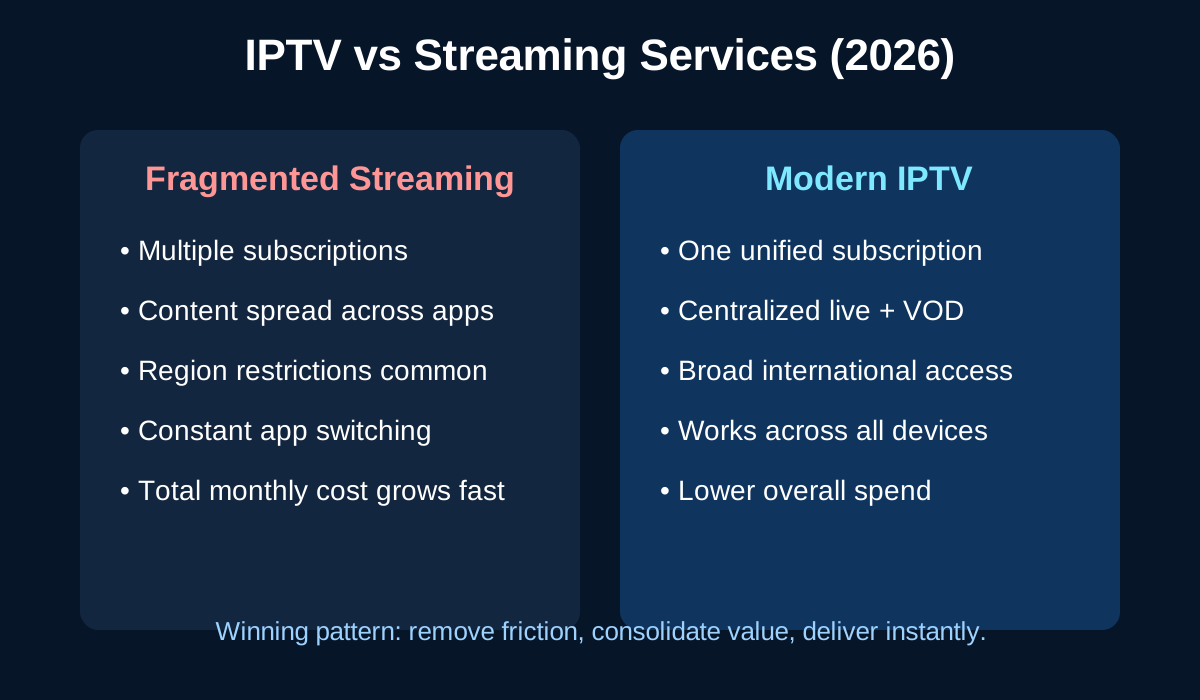
Quick comparison infographic table
| Decision area | Best practice | Why it matters |
|---|---|---|
| Legality | Choose services that communicate rights and terms clearly | Reduces risk and improves long-term availability |
| Internet speed | 10 Mbps for HD, 25 Mbps for 4K, plus household overhead | Prevents buffering during busy evening hours |
| Device | Use updated apps on reliable hardware | Old chipsets cause freezing, audio drift, and crashes |
| Support | Test response time before buying a long plan | Good support is a major reliability signal |
| EPG | Check guide data for your most-watched channels | A clean guide improves daily usability |
| Trial | Test during peak time, not only mornings | Peak congestion reveals real performance |
What IPTV actually is
IPTV means television delivered using internet protocol networks. Instead of receiving channels through satellite, cable, or terrestrial broadcast, your player requests a stream from a server and displays it on your device. This can include live channels, catch-up TV, video on demand, electronic programme guide data, and multi-device access. The experience feels simple when everything works, but behind the scenes it depends on server capacity, peering, device decoding, Wi-Fi quality, DNS speed, app stability, and content metadata.
The most successful households treat IPTV as a system rather than a single app. They know which device is the primary screen, which app is the backup, where login details are stored, how to restart the router, and what to test before a major sports event. This planning is not complicated, but it prevents most frustration. A five-minute checklist often saves hours of troubleshooting later.
Helpful-content evaluation checklist
Before committing to any subscription, score the service in the following categories. Give each area zero, one, or two points. A high-quality service should score at least twelve out of sixteen before you consider a longer package.
- Clear website with real contact options and plain explanations.
- Trial or short plan that lets you test before making a bigger commitment.
- Stable playback on the exact device you plan to use every day.
- Accurate channel categories and EPG information.
- Reasonable guidance about legal use, regional access, and terms.
- Fast support response with useful instructions rather than generic replies.
- Secure payment process and clear renewal policy.
- Practical setup documentation for smart TV, Android, Fire TV, Apple TV, mobile, and web players.
Network planning for reliable viewing
Most buffering complaints are not caused by a single issue. They are usually the result of several small weaknesses happening at once. A router may be old, the television may be far from the access point, the household may be downloading game updates, and the chosen app may be using a decoder mode that does not suit the device. When these factors overlap during an evening match, the stream looks worse than it should.
Start with your broadband plan. A single HD stream can work on modest speeds, but a modern household needs headroom. If two people stream while phones, consoles, cloud backups, and smart cameras are active, the connection must support more than the headline IPTV bitrate. Latency and packet loss matter too. A speed test can look acceptable while unstable Wi-Fi still causes micro-freezes. For the main TV, Ethernet remains the gold standard. If Ethernet is impossible, use a mesh node or a stronger 5 GHz connection and keep the player away from crowded 2.4 GHz channels.
Device recommendations and app workflow
Smart TVs are convenient because they remove extra boxes, but they are not always the fastest platform. Budget televisions can have weak processors and limited memory. If the app feels slow, a dedicated Android TV box, Fire TV device, or Apple TV can make the entire system more responsive. The best player is the one that receives updates, handles your playlist format, supports EPG refresh, and allows simple backup/export of settings.
For families, create a main profile for everyday channels and a separate favourites list for sports, kids, news, films, and international content. Do not leave every available channel in one huge list. Large lists are harder to search and can slow down older apps. A well-curated favourites folder feels more premium than an enormous unorganized playlist. Refresh EPG data weekly, remove dead favourites, and keep one backup app installed in case an update breaks your preferred player.
Content organization and viewing scenarios
A useful IPTV setup should serve real viewing scenarios. A parent may want children’s channels in one safe folder. A sports fan may need match-day channels placed at the top of a favourites list. An expatriate may want local news from home alongside regional channels in the country where they live. A film viewer may care more about subtitle support, VOD categories, and resume playback than about channel count.
This is why channel count alone is a weak buying signal. A service can advertise thousands of channels while the ones you actually need are poorly labelled or unstable. The better question is whether your top twenty channels work well at the times you watch them. During a trial, write down the exact programmes you tested, the time of day, the device, the app, and the result. That small log gives you evidence instead of relying on memory.
SEO, AEO, and GEO notes for publishers
For website owners publishing IPTV articles, the strongest long-term approach is to create pages that answer actual user questions. Search engines and AI answer systems increasingly reward pages that explain trade-offs clearly, use structured headings, include schema markup, and avoid misleading claims. A good article should define the topic, show comparison tables, answer FAQs, disclose practical limitations, and link to relevant resources with natural anchor text.
This page uses a clear title, meta description, canonical handling through the site layout, Article schema, Breadcrumb schema, and FAQ schema. Those elements help search engines understand the page, while the body copy provides context that answer engines can summarize. The result is not just keyword density; it is entity clarity, intent matching, and a better experience for the reader.
Safety and legal considerations
IPTV technology is neutral, but content rights are important. Viewers should choose services that are transparent about what they provide and how the subscription can be used. Avoid offers that promise impossible access with no terms, no support identity, and no explanation of rights. If a price seems unrealistically low, investigate carefully before sharing personal data or buying a long plan.
Use secure passwords, avoid sending login details through public channels, and keep payment records. If you use a VPN for privacy or travel, test whether it improves or worsens routing. Some VPN servers are overloaded and can increase buffering. Others may improve stability when an ISP route is congested. The only reliable answer is to test with your own connection.
Troubleshooting playbook
When playback fails, troubleshoot in a logical order. First, check whether other internet services work. Second, restart the player app. Third, test a different channel category. Fourth, switch from Wi-Fi to Ethernet or move closer to the router. Fifth, test a second app or device. Sixth, contact support with exact details: channel name, time, device, app version, error message, and whether other channels work. Specific reports are easier to fix than messages saying only that the service is down.
If buffering happens only on one channel, the issue may be source-specific. If every channel buffers, the issue may be local network, ISP routing, DNS, VPN, or device performance. If VOD works but live TV fails, the live server cluster may be under pressure. If live TV works but EPG is wrong, the metadata feed may need refreshing. Separating symptoms saves time.
Buyer checklist before a long subscription
Do not buy a long subscription until you have completed these checks. Test your primary channels. Test at least one sports or high-motion stream. Test subtitles if you need them. Test EPG data. Test catch-up if offered. Test on the main TV, not only a phone. Confirm renewal rules. Save setup instructions. Ask support one real question and judge the answer. Finally, compare the total annual cost with the value you actually receive, not just with the advertised channel count.
Final recommendation
The best IPTV experience in 2026 comes from combining a transparent provider, a stable home network, a modern device, organized favourites, and realistic expectations. Whether you search for iptv suomi, iptv finland, or iptv kanavat, use the same practical standard: legality, reliability, support, usability, and value. A service that performs well on those five criteria is more likely to remain useful after the excitement of the first setup day has passed.
Use this article as a repeatable checklist. Bookmark it, run the trial tests, document your results, and choose the option that solves your actual viewing needs rather than the one with the loudest marketing claim.
Practical maintenance calendar
A good IPTV setup improves when it is maintained lightly instead of ignored until something fails. Once a month, update the player app, clear unnecessary cache, refresh the programme guide, and remove channels you no longer watch from favourites. Every three months, review router firmware, Wi-Fi signal quality, device storage, and whether your broadband package still fits household usage. Before major events, test the exact channel at least one day in advance and keep a backup device ready. This routine is simple, but it creates a more dependable experience for families, sports viewers, and anyone who does not want to troubleshoot during prime time.
Publishers and business owners can use the same maintenance mindset for content. Update screenshots when apps change, refresh speed recommendations when codecs improve, add new FAQ answers when support teams see repeated questions, and remove outdated claims. Search performance is often strongest when an article stays accurate over time rather than being published once and forgotten. Helpful content is a living asset: it earns trust because it keeps matching the real questions users ask.
For readers using the exact query iptv kanavat, the most important practical step is still the same: test the channels you personally need, during the hours you normally watch, on the device you will actually use. Keyword matching can help you discover a provider, but real-world playback quality should decide whether you stay with it.
Frequently Asked Questions
What should I check before choosing a provider?
Check legal content rights, transparent support, trial access, device compatibility, EPG quality, uptime expectations, refund terms, and whether the service works reliably on your home network.
Which internet speed is enough for IPTV?
Plan for about 10 Mbps per HD stream and 25 Mbps or more per 4K stream, plus extra capacity for other household devices, Wi-Fi overhead, and peak-time congestion.
Which devices usually work best?
Modern smart TVs, Android TV boxes, Fire TV devices, Apple TV, tablets, phones, and PC players can all work well when the app is maintained and the network is stable.
How can I reduce buffering?
Use Ethernet where possible, improve Wi-Fi placement, restart the router, avoid overloaded VPN routes, choose a nearby server profile when available, and test at peak evening hours.
Ready to Experience Premium Nordic IPTV?
Try all 100,000+ channels free for 24 hours — no credit card required.
Get Free 24h Trial